
Release TMJ Pain, Tightness, and Jaw Tension by Resetting the Nervous System Pattern That Keeps Your Muscles Locked.
Learn a gentle, nervous-system-based approach that helps your jaw relax naturally-even if nothing else has worked before.
Tried Mouth Guards, Massage, Devices, And Still in Pain?
If your nervous system is stuck in tension mode, nothing else works.
Here's how to change that...and get your life back.
What TMJ Really Means for Your Body
TMJ (temporomandibular joint disorders, often called TMD) affects how your jaw moves and functions.
This joint connects your jaw to your skull, but when tension becomes chronic, the issue often extends beyond the joint itself.
A jaw that stays guarded keeps your nervous system locked in stress mode, making lasting relief impossible without retraining the pattern.
That's why TMJ pain is often linked to headaches, neck tension, posture changes, and ongoing muscle tightness - not just jaw discomfort.
Want the deeper explanation?
Read the full breakdown here.

TMJ affects more than just your jaw-it impacts your entire life.
Common TMJ Symptoms You Might be Ignoring
Jaw clenching or grinding (especially at night)
Facial tension or soreness
Headaches or migraines
Clicking or popping sounds
Neck and shoulder tightness
Ear fullness or ringing
Jaw locking
Difficulty eating or speaking
Weight loss from pain
Many people don't realize these symptoms are connected - or that they share the same root cause.
Why Most Treatments Fail and
What They're Not Telling You
Most TMJ treatments focus on managing symptoms - not addressing why the muscles stay tense in the first place.
Mouth guards, injections, medications, devices, and even surgery are commonly recommended. Yet many people find that relief is temporary, inconsistent, or comes with significant risk. In fact, leading health organizations caution against irreversible TMJ treatments - including surgery!
That's because these approaches don't address the underlying nervous system patterns that keep the jaw in a state of protection.
When the nervous system stays stuck in tension mode, lasting relief is difficult to achieve - no matter how aggressive the intervention.
Click here to read about: Real documented patient stories of TMJ treatments gone wrong.

Why A Different Approach Matters
Many people with TMJ find themselves moving from one intervention to the next - from devices and injections to invasive procedures - often without ever experiencing lasting relief.
What's often missing from this process is a clear explanation of why the jaw muscles stay tense in the first place. When treatment focuses only on the joint or the symptoms, the underlying pattern driving the tension is left unchanged.
This has led many people to step back and ask a different question:
What if TMJ pain isn't primarily a structural problem - but a functional one rooted in how the nervous system is regulating muscle tension?
To see what leading experts and national research institutions have uncovered about these treatment failures, read TMJ Treatments Shocking Research & Expert Warnings here.
What's Being Done About It
So with all this pain, confusion, and trial-and-error treatments, where does that leave TMJ care today?
The truth is, most conventional approaches still aim to correct or manage the jaw joint itself, through appliances, injections, medications, or surgical intervention, yet long-term outcomes remain inconsistent because the deeper driver of muscle tension is rarely addressed.
As awareness has grown, leading research institutions and health organizations have increasingly emphasized conservative, non-invasive approaches, acknowledging that aggressive or irreversible treatments often fail to resolve the root cause of TMJ symptoms.
What's becoming clearer is:
TMJ is not simply a structural jaw problem.
It's a muscle and nervous system problem.
One that requires a different strategy entirely.
Until you retrain the nervous system and release the chronic tension patterns in your muscles, the pain cycle continues.
That's EXACTLY why I created Unlock Your Jaw-to give you a proven, science-backed way to restore comfort and function without invasive procedures or endless guesswork.
Why TMJ Pain Rarely Stays Isolated
Jaw pain rarely exists in isolation.
When the underlying tension patterns aren't addressed, TMJ often extends beyond the jaw-
influencing surrounding muscles, posture, breathing, sleep, and the way the nervous system responds to stress.
Tendonitis and arthritis in the jaw joint
Ringing in the ears or ear discomfort
Tooth damage or difficulty chewing, speaking, or yawning
Sleep disturbances, including disrupted breathing
Chronic pain and tension in the neck and shoulders
Heightened stress, anxiety or emotional tension
These patterns don't appear overnight - they develop gradually as the nervous system adapts to ongoing tension.
The good news?
These patterns can change.
When you address the nervous system and the muscle tension it controls, the cycle doesn't have to continue.
What is Somatic Movement Exercises and why does it work?
Somatic Movement Exercises
work by retraining the nervous system-
the system that controls muscle tension, posture, and habitual movement patterns.
You see, the more we repeat a specific posture or movement,
even when it's intentional,
the more deeply that pattern becomes wired into the nervous system.
This is often referred to as ‘muscle memory.’
It's the nervous system's way of helping us
move more efficiently without conscious effort.
But sometimes those learned patterns
stay switched on when they're no longer needed-
keeping those muscles subtly contracted,
even at rest.
Over time, that constant background tension is what leads to pain.
You can lose voluntary control of your muscles-
meaning they stay tight even when you believe you're relaxed!
The good news is:
This muscle memory can be retrained.
Somatic Movement Exercises use a
gentle, awareness-based process called Pandiculation
to help reset chronic muscle tension at the nervous system level.
Pandiculation involves slowly and intentionally contracting a muscle -
then releasing it just as slowly-
allowing the nervous system to accurately sense how much tension is being held.
This process helps lower the baseline level of tension in the muscles, which is why pain often begins to ease - not temporarily, but sustainably!
Because Somatic Movement Exercises are an
active form of neuromuscular learning,
the results are cumulative and long-lasting.
The movements are taught in a specific and progressive order - tailored to the underlying patterns contributing to each person's type of pain.
Research has shown that Clinical Somatic Education is an effective and sustainable method for reducing pain.
Why Treating the Whole Tension Pattern Matters
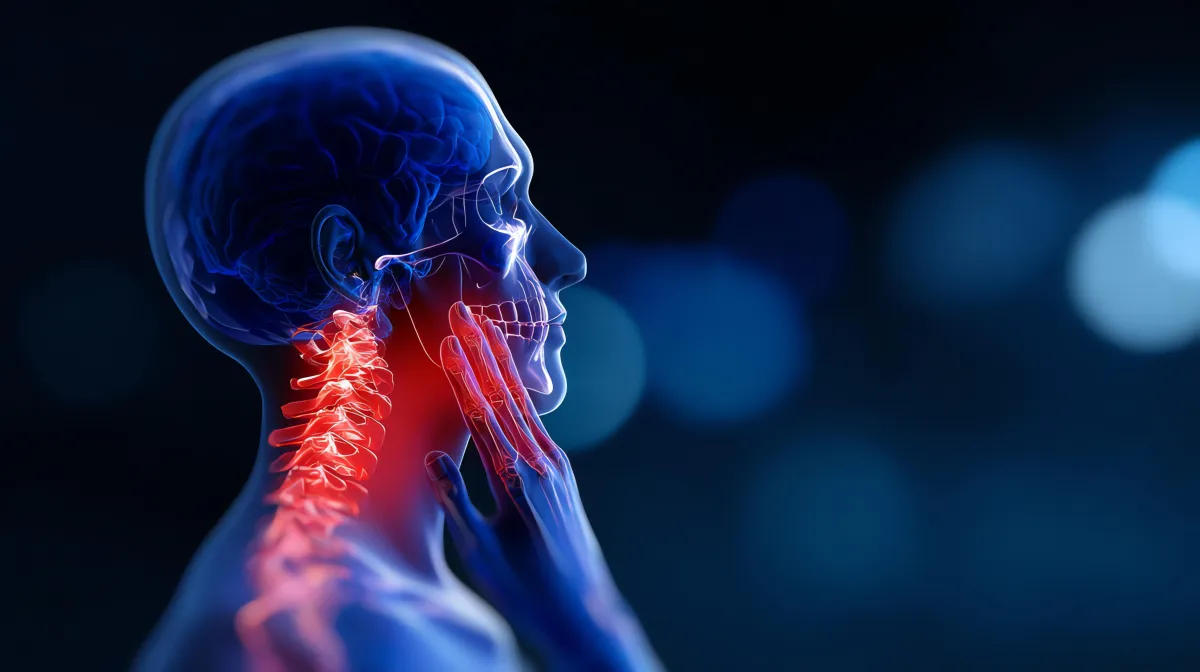
Jaw pain rarely exists on its own.
The muscles of the jaw are closely connected to the neck, shoulders, posture, and the nervous system's stress response.
When tension develops in one area, the body adapts by recruiting other muscles to stabilize and protect.
That's why focusing on the jaw alone often isn't enough.
To create lasting relief, the entire pattern of tension that the nervous System has learned needs to be addressed - not just the place where pain happens to show up.
Somatic Movement Exercises work by helping the nervous system recognize and release these interconnected patterns, allowing the jaw - and the rest of the body - to return to a more natural, relaxed state.
Your Active Participation is Key
Somatic Movement Exercises involve your active participation - and that's what makes them so effective.
Rather than something being done to your body, you are gently guided to move specific areas with awareness and control-allowing your nervous system to recognize and release long-held muscle tension.
This process helps retrain the nervous system to lower the baseline level of tension in the muscles, which is why relief can be lasting instead of temporary.
Most conventional approaches to TMJ and muscle pain are passive. Stretching, tools, or devices, and even many clinical interventions may offer short-term relief, but they don't teach the nervous system how to let go of chronic tension on its own.
When you actively take part in the process, your body learns how to reset - giving you back a sense of control, confidence, and comfort that passive methods simply can't provide.

How I Went From Jaw Pain and Hopelessness to Living Pain-Free

It wasn’t until much later, after years of ongoing tension, that I discovered Somatic Movement Exercises, and things finally began to change.
By learning how to retrain my nervous system and release the chronic tension patterns held in my muscles, my jaw finally let go in a way it never had before - and it stayed that way.
Over time, the tightness in my jaw and neck disappeared. The anxiety around dental visits faded. I could sit in the chair—and leave—without my jaw locking or tightening.
That experience is what inspired me to create Unlock Your Jaw—to help others who feel stuck, tense, or afraid that jaw pain is something they’ll just have to live with.
My jaw pain began after what should have been a routine dental appointment.
Following a simple procedure, my jaw was numbed—and once the numbness wore off, it didn’t return to normal.
My jaw locked into a painful position and stayed that way for months.
I couldn’t open my mouth fully.
Eating became stressful.
Conversations felt uncomfortable.
And over time, the constant tension began to take over more than just my jaw.
I experienced headaches and vision disturbances. I avoided eating with others because chewing was difficult and unpredictable.
I started to feel anxious in social situations—and eventually, hopeless that I would ever feel normal again.
Like many people when they're desperate for relief, I returned to the dentist repeatedly—six times in two weeks—trying to adjust a crown that felt like it was holding my jaw hostage.
I also tried massage and other conservative approaches. Some things helped temporarily, but nothing brought lasting relief.
After a few months, the intense pain eased—but the tension never truly left. Years later, my jaw was still tight.
Clicking and popping became normal. Every dental visit brought anxiety, wondering if the pain would return.
My jaw pain began after what should have been a routine dental appointment.
Following a simple procedure, my jaw was numbed—and once the numbness wore off, it didn’t return to normal.
My jaw locked into a painful position and stayed that way for months.
I couldn’t open my mouth fully.
Eating became stressful.
Conversations felt uncomfortable.
And over time, the constant tension began to take over more than just my jaw.
I experienced headaches and vision disturbances. I avoided eating with others because chewing was difficult and unpredictable.
I started to feel anxious in social situations—and eventually, hopeless that I would ever feel normal again.
Like many people when they're desperate for relief, I returned to the dentist repeatedly—six times in two weeks—trying to adjust a crown that felt like it was holding my jaw hostage.
I also tried massage and other conservative approaches. Some things helped temporarily, but nothing brought lasting relief.
After a few months, the intense pain eased—but the tension never truly left. Years later, my jaw was still tight.
Clicking and popping became normal. Every dental visit brought anxiety, wondering if the pain would return.
It wasn’t until much later, after years of ongoing tension, that I discovered Somatic Movement Exercises, and things finally began to change.
By learning how to retrain my nervous system and release the chronic tension patterns held in my muscles, my jaw finally let go in a way it never had before - and it stayed that way.
Over time, the tightness in my jaw and neck disappeared. The anxiety around dental visits faded. I could sit in the chair—and leave—without my jaw locking or tightening.
That experience is what inspired me to create Unlock Your Jaw—to help others who feel stuck, tense, or afraid that jaw pain is something they’ll just have to live with.
Here's Everything You'll Get When You Enroll Now!
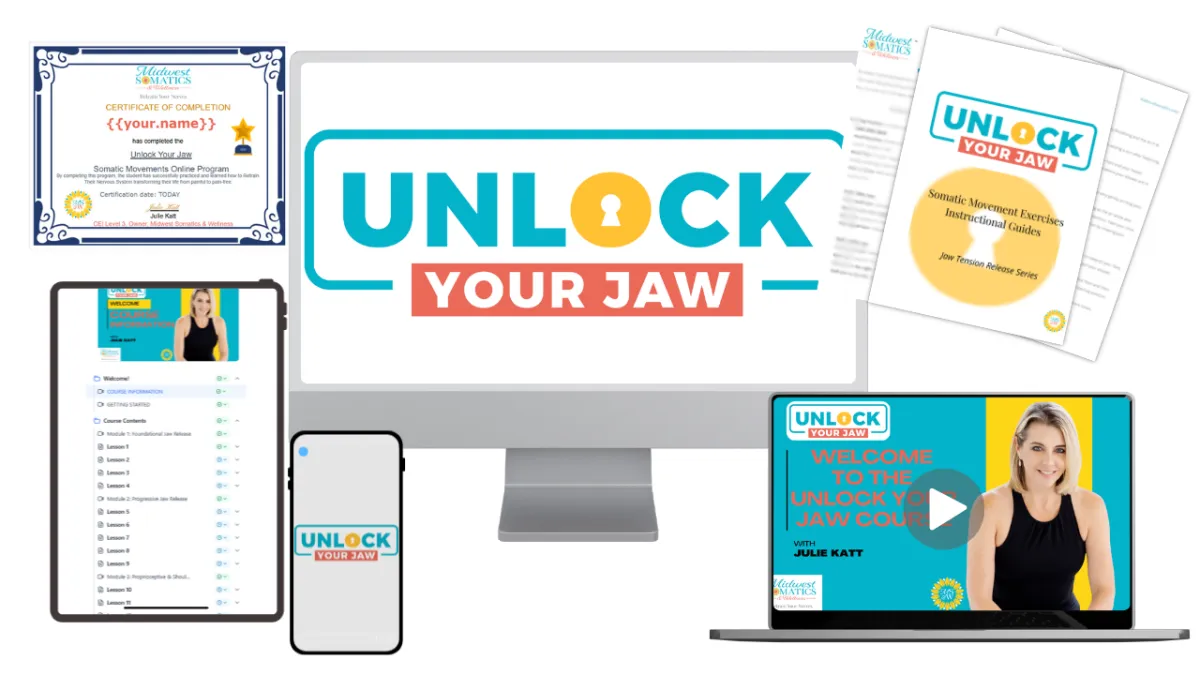
12 step-by-step video lessons taught in a specific order for “Unlock Your Jaw”
Over 2 hours of guided somatic movement video instruction, structured across a 36-day Unlock Your Jaw program
PDF downloadable instructions in each lesson for your home practice
Free Gift #1: Breathing Exercises (included in lesson 1)
Lower Belly Breathing to support your somatic movements, slow the nervous system, and help muscles release tension more effectively.
Free Gift #2: Access to a Private Community where you can share your experiences with others as you go through this painful to pain-free journey.
Total Value: $2,550
Normal Price: $1997
Special Launch Price: $497
America's Birthday Sale: $97*
*Expires July 31st, 2026
That's less than a doctor's visit.
One payment. Lifetime access.
Watch whenever you want.
Complete the program, then maintain thereafter.
By learning how to Retrain your nervous system you can Transform your life with these results:

Take control over your pain instead of feeling at its mercy

Move without the fear of returning or spiraling again

Return to the activities you avoided because of pain
These are just a few of the real-life benefits our students experience after completing the courses.

Copyright Midwest Somatics And Wellness, LLC 2026. All rights reserved | Privacy Policy | Terms & Conditions